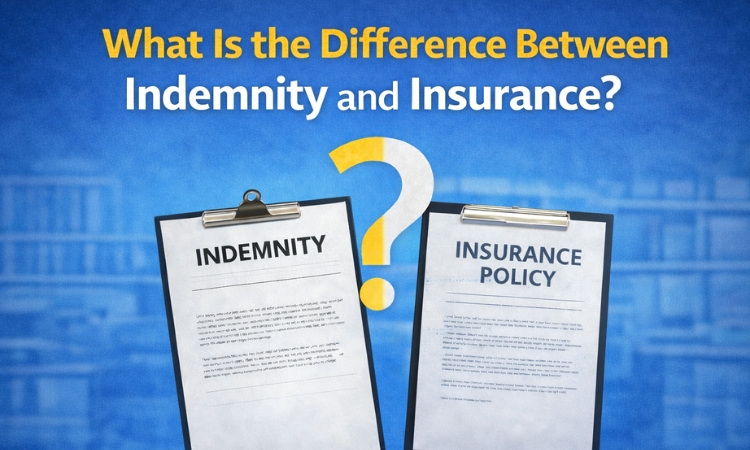
The terms indemnity and insurance are often used interchangeably, and this can cause confusion when purchasing or claiming an insurance policy. Although both terms are interlinked, they are not the same. It is important to understand the difference between indemnity and insurance before purchasing any insurance policy, particularly health or life insurance.
Understanding the difference between indemnity and insurance can help you avoid confusion while making a claim, choose the correct insurance policy, and manage your finances better. This article will help you understand the difference between indemnity and insurance in simple terms so that you can make informed decisions with confidence.
What Is a Contract of Indemnity?
A contract of indemnity is an agreement between two parties in which one party agrees to compensate the other for an actual loss incurred as a result of a particular event.
- Simple Definition
Indemnity is a term that refers to protection against loss. The insurer will only refund the actual amount of loss, nothing more, nothing less.
- Important Provisions of a Contract of Indemnity
- Loss must be actual
- Profit is not allowed on the claim
- Payment is made only after proof of damage
- The insured must have a financial interest in the subject matter
- Common Examples
- Reimbursement of medical bills from health insurance
- Claim for fire damage to a property
- Repair bills for a vehicle after an accident
- Why Indemnity Exists
- Loss Protection – Prevents financial hardship due to damage
- Fair Compensation – Only pays for what is lost
- No Unjust Gain – Prevents anyone profiting from insurance
- Risk Control – Promotes responsible behavior
- Financial Stability – Returns to original financial position
- Claim Transparency – Requires bills and documentation
Also Read: Importance of Financial Planning
What Is an Insurance Contract?
An insurance contract is a general contract where the insurer agrees to offer financial protection against uncertain future risks in exchange for a premium
How Insurance Works (Step-by-Step):
- Identifying the Risk
The insurance process starts with identifying a potential financial risk such as illness, accident, damage to property, or death. Identifying these risks helps a person understand what kind of protection they require. This step is crucial in choosing the best insurance policy.
- Purchasing the Insurance Policy
Once the risk has been identified, the person buys an insurance policy from an insurer in exchange for a fixed premium. The premium can be paid on a monthly, quarterly, or annual basis depending on the policy. In return, the insurer agrees to offer financial protection as per the terms of the policy.
- Risk Pooling by the Insurer
The insurance company pools the premiums from various policyholders into a single pool. This is called risk pooling. The purpose of risk pooling is to allow the insurance company to distribute the risk among a large number of people. This ensures that there are enough funds in the pool to pay the claims when they arise.
- Occurrence of the Insured Event
Once the insured event happens, such as hospitalization or an accident, the policyholder must notify the insurance company immediately. This is the final step that initiates the claim process as per the terms of the insurance contract.
- Claim Assessment and Verification
The insurance company assesses the claim by scrutinizing the documents submitted by the policyholder. In indemnity insurance, the policyholder must provide evidence of actual financial loss incurred to support the claim.
- Claim Settlement or Payout
After the claim is confirmed, the insurer pays off the claim as per the terms of the insurance policy. In indemnity insurance, the insurer pays off only the actual amount of loss incurred. However, in other types of insurance, a fixed payout amount may be offered.
Difference Between Indemnity and Insurance
| Point of Difference | Indemnity | Insurance |
|---|---|---|
| Meaning | Covers actual financial loss | Covers risk of uncertain events |
| Compensation | Only actual loss amount | May pay fixed or variable amount |
| Profit | No profit allowed | Depends on policy type |
| Proof Required | Mandatory | Not always required |
| Scope | Narrow | Broad |
| Example | Health reimbursement | Life insurance |
Indemnity is solely concerned with the repayment aspect, whereas insurance may include risk protection without calculating the loss amount, particularly in the case of life insurance.
Also Read: Difference Between SIP and Mutual Fund
Difference Between Contract of Indemnity and Life Insurance Contract
Feature | Indemnity Contract | Life Insurance |
Proof of Loss | Required | Not required |
Payment | Actual loss only | Fixed sum assured |
Human Life Value | Not applicable | Cannot be valued exactly |
Nature | Compensatory | Benefit-based |
How This Applies to Health Insurance
Health insurance operates on the indemnity principle, whereby the insurance company pays for the actual hospitalization costs.
- Where the Indemnity Principle Applies in Health Insurance
- Hospitalization bills
- Surgery costs
- Diagnostic tests
- ICU charges
- This applies to:
- Low cost health insurance
- Senior Citizen Health Insurance
- Family floater health plans
Why Understanding Indemnity is Helpful
- Reduces Confusion in Claims
Understanding the indemnity concept helps policyholders understand that only actual financial losses will be compensated. This eliminates misunderstandings during the claims process. It also eliminates conflicts with the insurer at the point of compensation.
- Aids in Selecting the Best Policy
Understanding indemnity concepts makes it easier to select the best policy according to actual needs. Policyholders can compare different policies effectively by understanding the limits of compensation. This is particularly helpful while selecting health insurance policies.
- Aids in Financial Planning
Understanding indemnity concepts helps individuals plan for emergency funds along with insurance coverage. Since the insurer compensates only actual losses, out-of-pocket expenses can still occur. Effective planning will result in better financial stability during medical emergencies.
- Aids in Better Coverage for Seniors
In the case of Senior Citizen Health Insurance, understanding indemnity concepts is essential because medical expenses are generally high. It helps seniors and their families select policies with sufficient sum insured and less sub-limits.
Why Awareness of Indemnity is Helpful
- Avoids Confusion in Claims
Awareness of the indemnity concept helps policyholders understand that only actual financial loss will be compensated. This avoids confusion in claims. It also avoids any conflict with the insurer at the time of compensation.
- Assists in Selecting the Best Policy
Awareness of the indemnity concept helps policyholders select the best policy according to their needs. They can compare different policies effectively by knowing the limits of compensation. This is particularly helpful while selecting health insurance policies.
- Assists in Financial Planning
Awareness of the indemnity concept helps policyholders plan their emergency funds along with insurance. Since the insurer compensates only for actual expenses, out-of-pocket expenses can still be incurred. Effective planning helps policyholders achieve better financial stability during medical emergencies.
- Helps in Selecting the Best Senior Citizen Health Insurance Policy
In the case of Senior Citizen Health Insurance, awareness of the indemnity concept is extremely important since medical expenses are high. It helps seniors and their families select the best policy with sufficient sum insured and less sub-limits.
Why This Difference Matters
The difference between indemnity and insurance is very important to understand in order to avoid any confusion during the settlement of claims. Many people who purchase insurance policies are expecting a certain amount of payment, but in indemnity-based policies, they are only paid for the actual loss they incurred. If the difference between the two is not clear, it may result in disappointment, disputes over claims, or misconceptions about insurance.
The difference between the two is also very important in selecting the correct insurance policy and managing finances properly. It will enable people to make the correct selection of insurance policies according to their actual needs and not according to their expectations of earning profits. In health insurance policies and senior citizen policies, the difference between indemnity will help people avoid being underinsured or overinsured.
Conclusion
The main difference between indemnity and insurance is that indemnity is based on compensation, where indemnity aims to restore the actual loss, whereas insurance offers wider risk protection, at times with fixed benefits. It is important to understand the difference between the two to avoid confusion in claims and select the correct policy.
With the right advice, it becomes easy to select the correct policy. Aspire Wealth is a trusted companion that assists individuals and families in selecting the correct insurance plans, such as low-cost health insurance and Senior Citizen Health Insurance, with full financial understanding and confidence.
FAQs
- Is life insurance an indemnity contract?
No. It is a benefit-based contract, not indemnity-based.
- Why is health insurance an indemnity contract?
Because it reimburses actual medical expenses incurred.
- Can indemnity contracts provide additional payment?
No. They only compensate for actual loss incurred.
- Does Senior Citizen Health Insurance operate on the indemnity principle?
Yes. It reimburses real hospital expenses.
- Can insurance contracts generate profit?
Only some types of insurance, such as life insurance, may generate profit.